Solar Panel Manufacturing Process Flow Chart
Unpacking the Solar Panel Manufacturing Process: Your Definitive Flow Chart Guide
Ever wondered what intricate dance of technology and precision transforms raw materials into those powerful, energy-harvesting rectangles on our roofs? You’re not alone. When you invest in solar, you’re buying into a complex feat of engineering, and understanding its origins can deepen your appreciation for clean energy.
Table of Contents
- Unpacking the Solar Panel Manufacturing Process: Your Definitive Flow Chart Guide
- What Are We Building? The Core Components of a Solar Panel
- The Silicon Cell: The Heart of the Panel
- Encapsulant Layers (EVA): Protection and Light Transmission
- Glass: The Front-Line Defender
- Backsheet: Moisture Barrier and Electrical Insulation
- Aluminum Frame: Structural Integrity
- Junction Box: Electrical Connection Point
- The Solar Panel Manufacturing Process Flow Chart: Step-by-Step Production
- Step 1: Silicon Ingot & Wafer Production (The Foundation)
- Step 2: Solar Cell Fabrication (Turning Wafers into Cells)
- Step 3: Cell Sorting & Stringing (Assembling the Power Grid)
- Step 4: Layup & Lamination (Building the Panel Sandwich)
- Step 5: Framing & Junction Box Attachment (Structural & Electrical Completion)
- Step 6: Final Testing & Quality Assurance (Ensuring Performance & Durability)
- Step 7: Packaging & Shipping (Ready for Installation)
- The Role of Automation and Sustainability in Modern Solar Manufacturing
- Automation: Speed, Precision, and Cost Reduction
- Sustainability: Reducing Waste, Energy, and Environmental Impact
- Why Quality Matters: Beyond the Flow Chart
This isn’t just about listing steps; it’s about giving you a true behind-the-scenes look at the journey from a speck of silicon to a fully functional solar panel. We’re going to break down the entire solar panel manufacturing process into an easy-to-follow flow chart, revealing the critical stages, the hidden complexities, and the rigorous quality checks that ensure your panels perform for decades.
What Are We Building? The Core Components of a Solar Panel
Before we dive into how they’re made, let’s quickly identify the key players. A solar panel isn’t just one thing; it’s a meticulously engineered sandwich of materials, each with a crucial role.
The Silicon Cell: The Heart of the Panel
This is where the magic happens. Made from highly purified silicon, these semiconductor wafers convert sunlight into electricity (the photovoltaic effect). They’re typically just a few hundred micrometers thick, incredibly fragile, and come in monocrystalline (uniform, higher efficiency) or polycrystalline (multi-crystal structure, slightly lower efficiency) varieties.
Encapsulant Layers (EVA): Protection and Light Transmission
Ethylene Vinyl Acetate (EVA) is a clear, adhesive polymer film. It’s used on both sides of the solar cells, acting like a protective cushion and sealing them against moisture and contaminants. Think of it as the glue that holds the sandwich together, while also allowing maximum sunlight to reach the cells.
Glass: The Front-Line Defender
This isn’t just any glass. It’s typically low-iron, tempered glass, designed to be highly transparent to sunlight, incredibly durable, and resistant to impacts (hail, debris) and extreme weather. It forms the primary protective barrier for the delicate cells.
Backsheet: Moisture Barrier and Electrical Insulation
Usually made of a polymer composite, the backsheet forms the rear protective layer of the panel. Its main jobs are to prevent moisture ingress, provide electrical insulation, and protect against UV degradation and physical damage from the back. It often comes in white, black, or clear.
Aluminum Frame: Structural Integrity
The anodized aluminum frame surrounds the entire panel, providing structural strength, protecting the edges of the laminated components, and offering a convenient mounting structure. It’s designed to withstand wind loads, snow loads, and the stresses of installation.
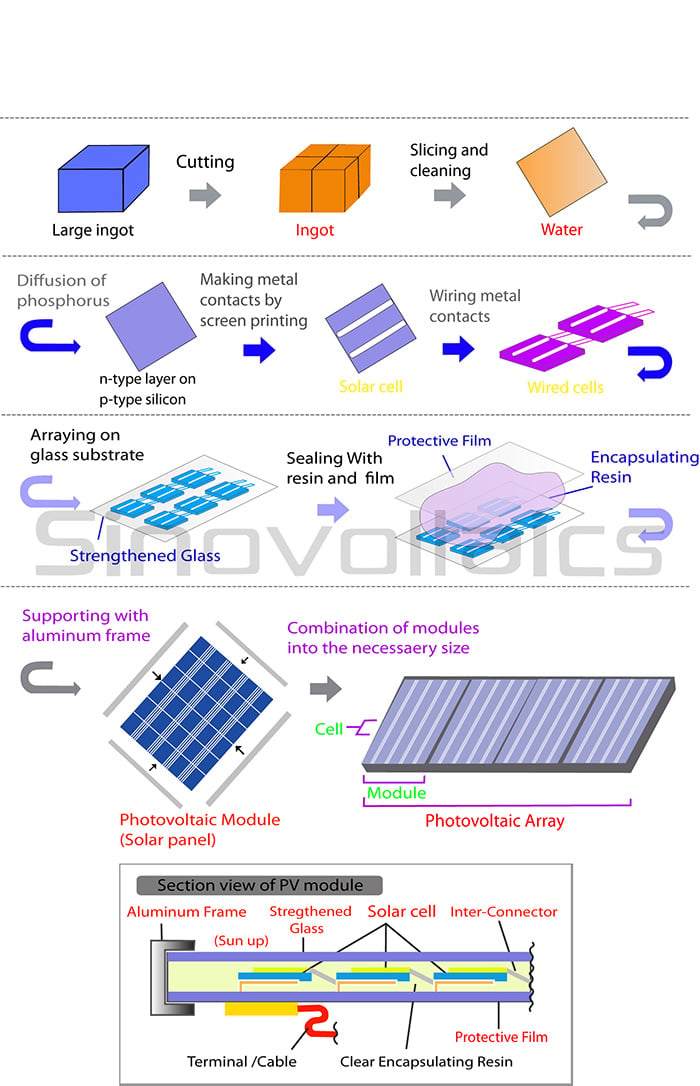
Junction Box: Electrical Connection Point
Mounted on the back of the panel, the junction box houses the bypass diodes, which protect the cells from overheating if a portion of the panel is shaded. It’s also where the positive and negative cables (typically MC4 connectors) exit the panel, allowing for easy connection to other panels or an inverter.
Here’s a quick overview of these components:
| Component | Primary Material | Key Function |
|---|---|---|
| Solar Cells | Silicon (Mono- or Polycrystalline) | Converts sunlight into DC electricity. |
| Front Glass | Tempered, Low-Iron Glass | Protects cells, maximizes light transmission. |
| Encapsulant (EVA) | Ethylene Vinyl Acetate | Seals and cushions cells, prevents moisture ingress. |
| Backsheet | Polymer Composite (e.g., Tedlar) | Electrical insulation, moisture barrier, UV protection. |
| Aluminum Frame | Anodized Aluminum | Structural support, mounting, edge protection. |
| Junction Box | Plastic Housing, Copper Wires, Diodes | Connects electrical wiring, houses bypass diodes. |
The Solar Panel Manufacturing Process Flow Chart: Step-by-Step Production
Alright, now for the main event! The manufacturing of solar panels is a multi-stage process, starting with raw silicon and ending with a highly efficient, durable module ready for installation. It’s a journey filled with precise engineering, high temperatures, and stringent quality control. Let’s trace this flow.
Step 1: Silicon Ingot & Wafer Production (The Foundation)
It all begins with silicon, the second most abundant element in Earth’s crust. But not just any silicon; it needs to be exceptionally pure.
- Purification: Raw metallurgical-grade silicon (about 98% pure) is processed through complex chemical reactions (like the Siemens process or fluidized bed reactor) to achieve solar-grade silicon, which is typically 99.9999% pure (known as “six nines”). This ultra-purity is crucial for efficient electron flow.
- Ingot Growth: The purified silicon is then melted at extremely high temperatures (over 1400°C). Depending on the type of panel, it’s either:
- Monocrystalline (Czochralski Method): A small seed crystal is dipped into the molten silicon and slowly pulled upwards, rotating as it cools. This forms a single, large, cylindrical crystal (ingot) with a highly uniform atomic structure.
- Polycrystalline: The molten silicon is simply poured into a large square mold and allowed to cool slowly. This results in an ingot composed of many smaller silicon crystals, giving it a characteristic variegated appearance.
- Ingot Shaping: The cylindrical monocrystalline ingots are typically squared off to maximize surface area utilization, while polycrystalline ingots are already block-shaped.
- Wafer Slicing: These large silicon ingots are then carefully sliced into thin wafers, usually 150-200 micrometers thick, using wire saws. Imagine slicing a giant salami with extremely fine wires to get consistent, delicate slices. This is a critical step, as minimal material loss means lower costs and higher efficiency.
Key Quality Check: At this stage, wafers are checked for consistent thickness, absence of cracks, and precise crystallographic orientation to ensure optimal performance in subsequent steps.
Step 2: Solar Cell Fabrication (Turning Wafers into Cells)
Now we transform those fragile silicon wafers into active photovoltaic cells. This is where their energy-converting properties are instilled.
- Texturing: The wafers undergo a chemical etch (typically with an alkaline solution) to create a microscopically rough, pyramidal surface. This texture significantly reduces light reflection, trapping more sunlight within the silicon and increasing absorption.
- Doping (Creating p-n Junction): This is the heart of the cell. The silicon wafer is naturally ‘p-type’ (doped with boron, creating positive charge carriers or ‘holes’). To create an electric field, a thin layer of ‘n-type’ material (doped with phosphorus, creating negative charge carriers or ‘electrons’) is diffused onto the front surface of the wafer in a high-temperature furnace. This creates the p-n junction, essential for the photovoltaic effect.
- Anti-Reflective Coating (ARC) Application: A thin layer of silicon nitride (SiN) or titanium dioxide (TiO2) is applied to the front surface. This coating further minimizes light reflection and also passivates the surface, reducing electron recombination losses. This gives solar cells their distinctive blue or black color.
- Metallization (Front & Back Contacts): To collect the generated electricity, metal contacts are applied. A full-surface aluminum layer is usually screen-printed and fired onto the entire back surface, forming the positive contact. On the front, a fine grid of silver paste (called busbars and finger lines) is screen-printed to form the negative contact. These contacts must be conductive but also allow maximum light to reach the silicon.
- Edge Isolation: The edges of the cell, where the n-type and p-type layers meet, are etched away. This prevents short-circuiting between the front and back contacts, ensuring proper current flow.
Key Quality Check: After fabrication, individual cells undergo rigorous testing, including:
- Flash Testing: Simulates sunlight at Standard Test Conditions (STC) to measure power output (watts).
- Electroluminescence (EL) Testing: An electric current is passed through the cell in darkness, causing it to emit infrared light. An infrared camera detects imperfections like micro-cracks, shunts, or contamination that are invisible to the naked eye. This is crucial for long-term reliability.
- Visual Inspection: For any cosmetic defects, chips, or scratches.
Step 3: Cell Sorting & Stringing (Assembling the Power Grid)
Individual cells are powerful, but to create a panel, they need to be precisely connected.
- Sorting: Cells are sorted based on their electrical characteristics (current, voltage, power). This ensures that cells with similar performance are grouped together, preventing mismatches that could reduce the overall panel output.
- Tabbing: Thin, flat copper ribbons (pre-soldered) are attached to the front-side busbars of each cell using automated soldering machines. These ribbons will carry the current from the cell.
- Stringing: The tabbing ribbons from the back of one cell are soldered to the front of the next, connecting cells in series to form a ‘string.’ Most standard panels use strings of 10-20 cells. This creates the desired voltage for the panel. Robotics ensure precise alignment and consistent solder joints.
Key Quality Check: Visual inspection for solder joint integrity and alignment. Automated systems measure the voltage of each string to confirm proper connection and performance.
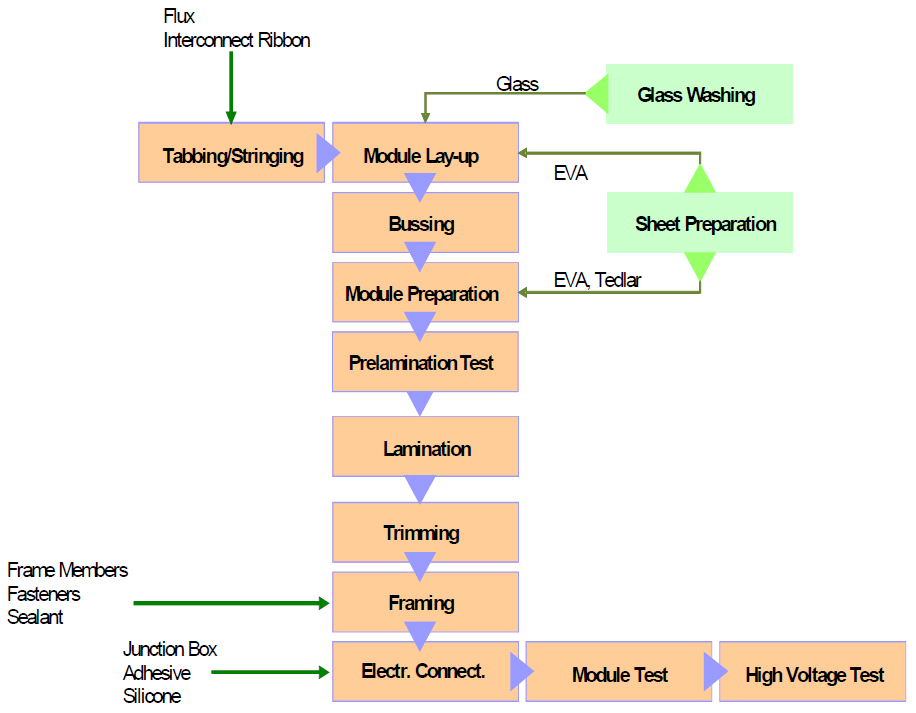
Step 4: Layup & Lamination (Building the Panel Sandwich)
This is where the individual components come together to form the ‘panel sandwich’.
- Preparation (Layup): The layers are carefully assembled in a cleanroom environment, typically in this order:
- Front Glass
- EVA Film (Bottom Layer)
- Arranged Strings of Solar Cells (precisely spaced and connected)
- EVA Film (Top Layer)
- Backsheet
The alignment is critical; even a slight misalignment can impact performance or aesthetics.
- Lamination: The entire ‘sandwich’ is placed into a laminator, which is essentially a large vacuum hot press. It undergoes a cycle of heat and vacuum:
- Vacuum Cycle: Air is removed to prevent bubbles and voids.
- Heating Cycle: Temperatures typically reach 135-150°C, causing the EVA film to melt, flow, and then cure, encapsulating the cells and permanently bonding all the layers together. This creates a durable, weather-sealed unit.
Key Quality Check: Post-lamination, panels are checked for any delamination, bubbles, or voids within the EVA. Adhesion tests are also performed to ensure the layers are securely bonded.
Step 5: Framing & Junction Box Attachment (Structural & Electrical Completion)
The laminated core is almost a panel, but it needs its protective shell and electrical outlet.
- Trimming: Any excess EVA or backsheet material extending beyond the laminated glass edges is precisely trimmed.
- Framing: The aluminum frame is then attached around the perimeter of the laminated panel. This is often done using specialized machinery that presses, crimps, or rivets the frame onto the edges, providing structural rigidity and protection. Drainage holes are also typically integrated into the frame.
- Junction Box Attachment: The pre-assembled junction box is affixed to the backsheet. The electrical ribbons from the cell strings are soldered to the bypass diodes and output cables within the junction box. This is the final point of electrical connection for the module.
Key Quality Check: Frame integrity, proper crimping/attachment, and crucial electrical connection testing within the junction box to ensure bypass diodes are functioning correctly and cables are securely fastened.
Step 6: Final Testing & Quality Assurance (Ensuring Performance & Durability)
Before leaving the factory, every panel undergoes a battery of tests to confirm it meets performance and safety standards.
- Flash Testing: This is a repeat of the cell-level flash test, but for the entire module. A controlled flash of light simulates standard sunlight conditions (1000 W/m², 25°C cell temperature, AM 1.5 spectrum), and the panel’s actual power output (Pmax), current (Imp), and voltage (Vmp) are precisely measured. The panel’s nameplate wattage is often derived from this test.
- Electroluminescence (EL) Testing: Another repeat, post-assembly. An electric current is passed through the finished panel in a dark room. An infrared camera captures images, revealing any hidden defects like micro-cracks, solder joint issues, or cell damage that might have occurred during assembly. These are critical for identifying potential hot spots or premature degradation.
- Insulation & Dielectric Withstand Testing: These tests ensure the panel’s electrical insulation is robust, preventing current leakage and ensuring user safety. High voltages are applied to check for breakdowns in insulation between active parts and the frame.
- Visual Inspection: A final, thorough human and/or automated visual inspection checks for any surface defects, scratches, foreign objects, or aesthetic imperfections.
These quality control steps are non-negotiable. They ensure that the panels leaving the factory will perform as advertised and last for their warranted lifespan. Here’s a summary of critical checks:
| Manufacturing Stage | Critical Quality Control Check | Why it Matters |
|---|---|---|
| Silicon Ingot & Wafer Production | Purity analysis, wafer thickness/flatness, crystallographic defects. | Ensures foundation material meets electrical requirements and prevents future cell damage. |
| Solar Cell Fabrication | Efficiency testing (Flash), Electroluminescence (EL) imaging, visual inspection, surface resistance. | Guarantees individual cells meet power output specs and are free from hidden defects. |
| Cell Sorting & Stringing | Current/voltage matching, solder joint integrity, string voltage measurement. | Prevents performance loss due to mismatched cells and ensures robust electrical connections. |
| Layup & Lamination | Vacuum integrity check, delamination/void detection, adhesion strength. | Ensures weather resistance, prevents moisture ingress, and guarantees long-term structural integrity. |
| Framing & Junction Box | Frame strength, junction box wiring continuity, bypass diode function. | Provides mechanical protection, ensures safe electrical connections, and prevents hot spots. |
| Final Testing | Module Flash Test (Pmax), EL imaging, Insulation Resistance (IR), Visual Inspection. | Confirms final module power output, detects any post-assembly damage, and ensures electrical safety. |
Step 7: Packaging & Shipping (Ready for Installation)
Finally, the certified solar panels are carefully cleaned, packaged in protective materials (often cardboard and plastic wrapping), and crated for safe transportation to distributors, installers, and ultimately, to your rooftop.
The Role of Automation and Sustainability in Modern Solar Manufacturing
The solar industry is constantly evolving, and manufacturing is no exception. Modern factories are marvels of efficiency and environmental consciousness.
Automation: Speed, Precision, and Cost Reduction
Robotics and advanced automation play a massive role in today’s solar panel production. From handling delicate wafers to precise soldering, automated systems ensure:
- High Throughput: Panels are produced rapidly, meeting global demand.
- Unmatched Precision: Robots can perform repetitive tasks with microscopic accuracy, far exceeding human capabilities.
- Reduced Costs: Automation lowers labor costs and minimizes errors and material waste, contributing to more affordable solar energy.
- Improved Safety: Hazardous processes can be managed by machines, protecting human workers.

Sustainability: Reducing Waste, Energy, and Environmental Impact
Leading solar manufacturers are also deeply committed to sustainability. This includes:
- Energy Efficiency: Manufacturing plants themselves are often powered by solar, reducing their carbon footprint.
- Material Recycling: Efforts are made to recycle silicon scraps, glass, and other materials within the production process.
- Water Conservation: Advanced water treatment systems minimize water usage in etching and cleaning processes.
- Responsible Sourcing: Ensuring raw materials are ethically and sustainably sourced.
- End-of-Life Recycling: Developing programs and technologies for recycling panels at the end of their 25-30+ year lifespan, extracting valuable materials like silicon, silver, and aluminum.
Why Quality Matters: Beyond the Flow Chart
You now have a solid understanding of the manufacturing journey. But why does all this meticulous detail and relentless quality control truly matter for you, the end-user?
- Long-term Performance: A well-manufactured panel will maintain its efficiency for decades, consistently generating power as promised. Poor quality can lead to rapid degradation.
- Warranty & Reliability: Reputable manufacturers offer 25-30 year performance warranties because they trust their process. Shoddy manufacturing can void warranties or lead to early failures, leaving you with underperforming assets.
- Return on Investment: Your solar system is an investment. High-quality panels ensure you get the maximum energy output and financial savings over the system’s lifetime, delivering a stronger return on that investment.
- Safety: Proper insulation, durable connections, and robust framing contribute to a safe electrical system on your property, minimizing risks of fire or electrical hazards.
The journey from raw silicon to a fully functional solar panel is a testament to human ingenuity and manufacturing precision. It’s a multi-step, highly controlled process designed to create a durable, efficient device that can reliably convert sunlight into clean electricity for a quarter-century or more. By understanding this intricate flow, you can better appreciate the technology powering our sustainable future.
Frequently Asked Questions
How long does it take to manufacture a solar panel?
The actual assembly line process for a single solar panel, from cell stringing to final testing, can be remarkably fast, often less than an hour, thanks to advanced automation. However, the entire manufacturing chain, starting from raw silicon purification and ingot growth, can take several days or even weeks due to the complex chemical and thermal processes involved before the cells even reach the module assembly line.
What is the most expensive part of a solar panel to manufacture?
Historically, the silicon solar cells themselves have been the most expensive component, accounting for a significant portion of the total cost due to the high purity silicon required and the complex fabrication steps. However, continuous innovation and economies of scale have steadily driven down cell costs, with other components like the glass, frame, and particularly the encapsulant materials also contributing substantially to the overall expense.
Are all solar panels manufactured the same way?
While the fundamental steps (wafer production, cell fabrication, module assembly, testing) are common to most crystalline silicon solar panels, there are variations. Monocrystalline and polycrystalline panels have different ingot growth methods. Thin-film solar panels, for example, use entirely different processes, depositing semiconductor materials onto a substrate. Even within crystalline silicon, manufacturers use proprietary techniques, automation levels, and specific material suppliers, leading to differences in efficiency, durability, and cost.
What kind of quality control is performed during manufacturing?
Quality control is rigorous throughout the entire process. Key checks include silicon purity analysis, wafer thickness and defect inspection, individual solar cell efficiency testing (flash tests), Electroluminescence (EL) imaging to detect micro-cracks or hidden defects, visual inspections for cosmetic flaws, insulation resistance tests, and final module flash testing to verify actual power output under standard conditions.
Where are most solar panels manufactured globally?
Currently, a significant majority of solar panels and their components are manufactured in Asia, with China being the dominant global producer. Other key manufacturing hubs include Southeast Asian countries, and to a lesser extent, Europe and North America, though efforts are being made to expand domestic manufacturing capabilities in these regions.
What is the typical lifespan of a manufactured solar panel?
Most modern solar panels are designed and warranted to last for 25 to 30 years or even longer. Performance warranties typically guarantee that the panels will still produce at least 80-85% of their original rated power output after 25 years. The actual physical lifespan can extend beyond these warranty periods, often reaching 30-40 years with proper installation and maintenance.
What happens to solar panels at the end of their life?
At the end of their operational life, solar panels can and should be recycled. Recycling programs are growing globally, focusing on recovering valuable materials like silicon, aluminum (from the frame), glass, copper, and silver. While the process is still evolving to become more economically viable and widespread, it helps reduce waste and reclaims resources for new manufacturing.


Post Comment