Grid Tie Solar Inverter Connection Diagram
Unlocking Your Solar Potential: The Definitive Guide to Grid-Tie Solar Inverter Connection Diagrams
So, you’ve decided to go solar. Fantastic! You’re ready to harness the sun’s power, reduce your energy bills, and contribute to a greener planet. But then you stare at a diagram full of lines, boxes, and symbols, and suddenly, the dream feels a little… complicated. Don’t worry, you’re not alone. Understanding the grid-tie solar inverter connection diagram is crucial, not just for a successful installation but for ensuring safety and compliance. Think of this as your personal blueprint translator, breaking down every connection point so you can confidently integrate your system with the utility grid.
Table of Contents
- Unlocking Your Solar Potential: The Definitive Guide to Grid-Tie Solar Inverter Connection Diagrams
- Core Components of Any Grid-Tie Solar System Diagram
- Solar Panels (PV Array)
- Grid-Tie Inverter (GTI)
- AC Disconnect Switch
- AC Service Panel (Breaker Box)
- Utility Meter (Net Metering)
- Grounding System
- The Two Main Grid-Tie Connection Philosophies: Load Side vs. Supply Side
- Load-Side Connection Diagram Explained
- Supply-Side Connection Diagram Explained
- Deeper Dive: Connection Diagrams for Different Grid-Tie Inverter Types
- String Inverter System Connection Diagram
- Microinverter System Connection Diagram
- Hybrid Inverter System Connection Diagram (with Battery Backup)
- Essential Considerations & Best Practices for Your Diagram
- National Electrical Code (NEC) Compliance
- Local Permitting & Utility Interconnection Agreements
- Proper Grounding Techniques
- System Sizing and Breaker Sizing
- Labeling and Documentation
- Common Pitfalls and Troubleshooting Grid-Tie Inverter Connections
- Reverse Polarity
- Incorrect Breaker Sizing
- Poor Grounding
- Inverter Error Codes
- Utility Disconnection Issues
- Preparing for Installation: What You Need to Know
- Gathering Your Tools & Materials
- Safety Gear is Paramount
- Consulting with Professionals (Even for DIY)
- Grid-Tie Inverter Connection Diagram Comparison
In this comprehensive guide, we’re cutting through the jargon and showing you exactly how a grid-tie solar inverter connects to your home and the utility grid. We’ll explore the essential components, demystify different connection types, and arm you with the knowledge to either confidently plan your DIY project or intelligently oversee your professional installers. Let’s get you connected!
Core Components of Any Grid-Tie Solar System Diagram
Before we dive into the intricate wiring, let’s establish the main players in any grid-tie solar system. Think of these as the fundamental building blocks you’ll see in every connection diagram.
Solar Panels (PV Array)
These are the stars of the show! Solar panels, or photovoltaic (PV) modules, convert sunlight into direct current (DC) electricity. They’re typically mounted on your roof or a ground-mount structure. In a diagram, you’ll see them represented as squares or rectangles with a ‘+’ and ‘-‘ sign, often connected in series or parallel to form an array.
Grid-Tie Inverter (GTI)
The inverter is the brain of your solar system. Its primary job is to convert the DC electricity generated by your solar panels into alternating current (AC) electricity, which is what your home appliances use and what the utility grid accepts. It also synchronizes with the grid’s frequency and voltage. In diagrams, the inverter often looks like a box with DC inputs and AC outputs, sometimes labeled ‘GTI’.
AC Disconnect Switch
This is a critical safety component. The AC disconnect switch provides a manual means to completely sever the AC power connection between your inverter and your home’s electrical panel/utility grid. This is vital for utility workers during maintenance or emergencies, and for your own safety. You’ll usually see it depicted as a switch box, often located outdoors near the inverter or meter.
AC Service Panel (Breaker Box)
Your home’s main electrical panel, also known as the breaker box or distribution board, is where the AC electricity from your solar inverter feeds into your home’s electrical system. It contains circuit breakers that protect individual circuits from overcurrent. In a diagram, this is a central box with multiple outgoing lines representing circuits, and an incoming line from your solar system typically connected to a dedicated breaker.
Utility Meter (Net Metering)
This is how your energy usage (and production!) is tracked. For grid-tie systems, you’ll typically have a bi-directional or ‘net meter’. This meter spins forward when you’re drawing power from the grid and backward when your solar system is producing more electricity than your home is consuming, effectively sending excess power back to the grid. The utility meter is the last point of connection before the public utility lines.
Grounding System
A robust grounding system is non-negotiable for safety. It provides a path for fault currents to safely dissipate into the earth, preventing electrical shock and protecting equipment. In diagrams, you’ll see grounding wires (often green or bare copper) connecting panels, inverter chassis, and the main electrical panel to a ground rod or building’s grounding electrode system.
The Two Main Grid-Tie Connection Philosophies: Load Side vs. Supply Side
When it comes to physically connecting your grid-tie solar inverter to your home’s electrical system, there are two primary methods. Understanding the difference is key to interpreting your specific diagram and ensuring compliance with local codes and utility requirements.
Load-Side Connection Diagram Explained
The load-side connection is by far the most common method for residential solar installations. In this scenario, your solar inverter connects to an existing circuit breaker within your home’s main AC service panel (breaker box). The solar electricity feeds into the panel, essentially becoming another source of power for your home’s ‘loads’ (appliances, lights, etc.).
How it works in the diagram:
- Your solar panels generate DC electricity.
- This DC power goes to your grid-tie inverter, where it’s converted to AC.
- From the inverter, the AC power runs through an AC disconnect switch.
- Then, it connects to a dedicated circuit breaker inside your existing main AC service panel. This breaker effectively acts as the ‘input’ from your solar system.
- The power then mixes with the utility power within your panel, feeding your home’s loads first.
- Any excess power flows through your utility meter and out to the grid.
Pros: Generally simpler to install, uses existing infrastructure, often preferred for smaller residential systems. Easier to get approved by utilities as it leverages established breaker panel capacity rules.
Cons: Limited by the existing busbar capacity of your main panel. If your solar array is very large, you might hit the 120% rule (NEC 705.12(B)(2)), requiring a service panel upgrade or a supply-side connection.
Supply-Side Connection Diagram Explained
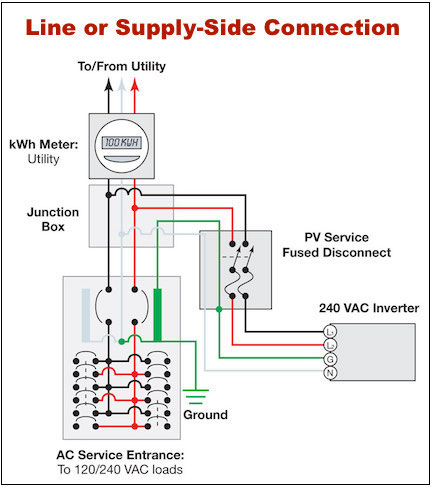
A supply-side connection, sometimes called a ‘line-side’ connection, bypasses your main service panel’s internal busbar. Instead, the solar system connects directly to the utility’s service entrance conductors, *before the main breaker but after* the utility meter (or sometimes directly at the meter enclosure). This method is typically used for larger residential or commercial systems where the solar array’s output might exceed the main panel’s capacity, or when a panel upgrade isn’t feasible.
How it works in the diagram:
- Solar panels generate DC electricity, which is converted to AC by the inverter.
- The AC power goes through an AC disconnect switch, often located very close to the meter or service entrance.
- Crucially, it connects directly into the service conductors between the utility meter and your home’s main service panel’s main breaker. This usually requires a specialized tap or a dedicated breaker in a meter combo panel.
- This connection point means the solar electricity feeds directly into the main utility supply to your home, rather than through an existing breaker.
Pros: Allows for larger solar systems that would otherwise exceed main panel capacity. Bypasses the 120% rule limitations.
Cons: More complex installation, often requires utility coordination and specialized equipment (e.g., tap kits or new meter panels). Can be more expensive and requires a deeper understanding of utility service entrance wiring.
Deeper Dive: Connection Diagrams for Different Grid-Tie Inverter Types
The general principle of converting DC to AC and connecting to the grid remains constant, but the specific wiring between your panels and the inverter varies significantly depending on the inverter technology you choose. Let’s break down the connection diagrams for the most common types.
String Inverter System Connection Diagram
A string inverter system is the traditional and often most cost-effective choice. Here, multiple solar panels are wired in series to form a ‘string,’ increasing the voltage. These strings then feed into a single, central inverter.
Detailed flow in the diagram:
- PV Array: Individual solar panels are connected in series (positive to negative) to create a string. Larger systems might have multiple strings connected in parallel to increase current, each feeding into the inverter.
- DC Combiner Box (Optional): For systems with multiple strings, a DC combiner box might be used. This box combines the output of several strings into a single, higher-current DC input for the inverter, often including string-level fusing for protection.
- DC Disconnect Switch: A manual DC disconnect switch is installed between the PV array (or combiner box) and the string inverter. This allows for safe shutdown of the DC power from the panels.
- String Inverter: The DC power enters the string inverter. Here, it’s converted into AC power and synchronized with the grid.
- AC Disconnect Switch: The AC output from the inverter passes through an external AC disconnect switch for safety.
- Main AC Service Panel: The AC power from the disconnect then connects to a dedicated breaker in your home’s main electrical panel (load-side connection) or directly to the service entrance (supply-side connection).
- Utility Meter: Finally, the power flows through the utility meter to your home’s loads or to the grid.
Key considerations: String sizing (ensuring proper voltage and current for the inverter), potential for shading on one panel to reduce output for the entire string, and the importance of a well-ventilated location for the inverter.
Microinverter System Connection Diagram
Microinverters represent a more modern approach. Instead of a single central inverter, each individual solar panel has its own small inverter attached directly to its back. This converts DC to AC right at the panel level.
Detailed flow in the diagram:
- PV Array: Each solar panel connects directly to its own microinverter.
- Microinverters: The microinverter, typically mounted on the racking beneath each panel, converts the panel’s DC output into AC power.
- AC Trunk Cable: The AC output from each microinverter connects to a specialized ‘trunk cable’ (often proprietary to the microinverter brand). This cable usually has pre-built connectors at set intervals for easy plug-and-play installation of microinverters.
- AC Junction Box: The trunk cable usually terminates in an AC junction box, where the combined AC power from all microinverters is collected.
- AC Disconnect Switch: From the junction box, the AC power flows through an external AC disconnect switch.
- Main AC Service Panel: The AC power then connects to a dedicated breaker in your main electrical panel.
- Utility Meter: The final connection point before the grid.
Key considerations: Panel-level power optimization (shading on one panel won’t significantly affect others), easier expansion, panel-level monitoring, and inherent rapid shutdown capability (as DC is contained at each panel). The AC voltage output from microinverters typically matches household voltage (e.g., 240V).
Hybrid Inverter System Connection Diagram (with Battery Backup)
A hybrid inverter system combines the functionality of a grid-tie inverter with the ability to manage battery storage. This gives you the best of both worlds: grid-tied benefits and backup power during outages.
Detailed flow in the diagram:

- PV Array: Solar panels generate DC electricity.
- Hybrid Inverter: This intelligent inverter takes the DC input from the panels and can do several things: convert it to AC for home use/grid export, or charge a connected battery bank with DC power directly.
- Battery Bank: A bank of batteries (e.g., lithium-ion, lead-acid) is connected to the hybrid inverter. The inverter manages charging and discharging, ensuring optimal battery health and providing power during outages.
- Critical Load Panel (Optional but Recommended): For backup power, a separate ‘critical load panel’ is often installed. During a grid outage, the hybrid inverter isolates your home from the grid and powers only the circuits connected to this critical load panel using solar and/or battery power.
- Main AC Service Panel: The AC output from the hybrid inverter (when operating grid-tied) connects to your main electrical panel, similar to a standard grid-tie system.
- AC Disconnect Switch: An external AC disconnect is still required between the inverter’s AC output and the service panel/grid.
- Utility Meter: The point of interaction with the grid.
Key considerations: More complex wiring due to battery integration, higher initial cost, but offers energy independence and resilience. Understanding power flow during grid-tied operation versus islanded (backup) operation is crucial for diagram interpretation.
Essential Considerations & Best Practices for Your Diagram
A diagram is just the starting point. To move from paper to a functional, safe, and legal system, you need to understand the underlying rules and best practices.
National Electrical Code (NEC) Compliance
In the USA, the National Electrical Code (NEC) (NFPA 70) is the cornerstone of electrical safety, and it has extensive sections dedicated to solar PV systems (e.g., Article 690). Any grid-tie solar inverter connection diagram must conform to these standards. This includes:
- Wire Sizing: Proper wire gauge for DC and AC circuits to prevent overheating and voltage drop.
- Conduit Requirements: Protection for wiring, especially outdoors.
- Overcurrent Protection: Fuses or circuit breakers at appropriate points to protect wires and equipment.
- Rapid Shutdown: A critical safety feature (NEC 690.12) that quickly de-energizes PV conductors to a safe level during emergencies, primarily for firefighter safety. Your diagram should illustrate how this is achieved (e.g., via microinverters, optimizers with rapid shutdown, or specific string inverter features).
- Labeling: Clear, durable labels indicating disconnects, voltage, and system components.
Ignoring NEC requirements isn’t just risky; it will prevent your system from passing inspection.
Local Permitting & Utility Interconnection Agreements
Before you even think about connecting wires, you need approval. Every grid-tie system requires:
- Building Permits: From your local Authority Having Jurisdiction (AHJ), ensuring structural integrity, electrical safety, and zoning compliance.
- Utility Interconnection Agreement: A formal contract with your utility company. This specifies how your system will connect to their grid, net metering terms, and safety protocols. They’ll also review your proposed connection diagram.
These approvals ensure your system is legal, safe, and eligible for net metering or other incentives.
Proper Grounding Techniques
We touched on grounding earlier, but it’s worth re-emphasizing. A correctly implemented grounding system protects against lightning strikes, ground faults, and ensures that exposed metal parts of your system remain safe to touch. Your diagram will show bonding of all metallic equipment (panel frames, racking, inverter chassis, conduit) to an equipment grounding conductor, which then ties into your home’s main grounding electrode system (e.g., ground rods, metallic water pipes).
System Sizing and Breaker Sizing
Your connection diagram isn’t just about lines; it’s about numbers. The size of your solar array (kW) and inverter capacity (kW) must be appropriately matched to your home’s electrical service and energy needs. Specifically:
- Inverter Output: The maximum AC output of your inverter dictates the size of the circuit breaker it connects to in your main panel.
- Busbar Rating: The main electrical panel has a busbar rating. The 120% rule (NEC 705.12(B)(2)) dictates that the sum of the main breaker and the solar backfeed breaker cannot exceed 120% of the busbar rating (for load-side connections). This often determines if you need a supply-side connection or a panel upgrade.
These calculations are critical for safety and system functionality.
Labeling and Documentation
A well-documented and labeled system is a safe and maintainable system. Your diagram should be complemented by clear labels on all disconnects, conduits, and equipment. This helps emergency responders, maintenance technicians, and future homeowners understand the system quickly and safely. Keep a copy of your final, approved connection diagram with your important home documents.
Common Pitfalls and Troubleshooting Grid-Tie Inverter Connections
Even with a perfect diagram, real-world installations can hit snags. Knowing common pitfalls can save you time, money, and frustration.
Reverse Polarity
Connecting DC wires with incorrect polarity (positive to negative, or vice-versa) is a classic mistake. While modern inverters often have protection against this, it can damage equipment or prevent the system from operating. Always double-check your DC connections from the panels to the inverter, ensuring positive goes to positive and negative to negative.
Incorrect Breaker Sizing
Connecting a solar inverter to an undersized or oversized breaker in your main panel can lead to issues. An undersized breaker will trip prematurely, preventing your system from operating at full capacity. An oversized breaker might not offer adequate protection for the wiring or the inverter, creating a fire hazard. Always adhere to NEC and manufacturer specifications for breaker sizing.
Poor Grounding
A loose or improperly connected ground wire can lead to intermittent fault conditions, inverter errors, and severe safety risks. Ensure all grounding connections are tight, corrosion-free, and meet code. Use a multimeter to verify continuity to ground where required.
Inverter Error Codes
Inverters are smart and will display error codes if something is wrong. Common issues indicated by error codes include grid voltage/frequency outside limits, ground faults, arc faults, DC overvoltage/undervoltage, or internal component failures. Always consult your inverter’s manual for specific error code interpretations and troubleshooting steps.
Utility Disconnection Issues
If your system isn’t connecting to the grid, or if it frequently disconnects, check a few things: Is the AC disconnect switch ON? Has the utility completed their final interconnection? Is the grid voltage or frequency stable? Sometimes, a utility upgrade or local grid instability can cause your inverter to shut down as a safety measure.
Preparing for Installation: What You Need to Know
Whether you’re tackling a DIY project or working with professionals, preparation is paramount. A clear understanding of your connection diagram is your foundation.
Gathering Your Tools & Materials
Ensure you have all the necessary components as specified in your diagram: appropriately sized wire, conduit, junction boxes, breakers, disconnect switches, and mounting hardware. Don’t forget specialized solar tools like MC4 crimpers for DC connections (if using string inverters) and a good multimeter for testing.
Safety Gear is Paramount
Working with electricity, especially high-voltage DC and AC, is inherently dangerous. Always wear appropriate personal protective equipment (PPE): insulated gloves, safety glasses, and sturdy footwear. Never work on live circuits without proper training and precautions. Always verify circuits are de-energized before touching them.
Consulting with Professionals (Even for DIY)
Even if you plan to do much of the work yourself, it’s highly recommended to have a licensed electrician review your connection diagram and your plans. They can catch critical errors, ensure NEC compliance, and perform the final tie-in to your main electrical panel, which often requires professional licensure.
Grid-Tie Inverter Connection Diagram Comparison
To help you visualize the differences we’ve discussed, here’s a comparative overview of the main grid-tie inverter types and their key connection characteristics:
| Feature | String Inverter System | Microinverter System | Hybrid Inverter System (with Battery) |
|---|---|---|---|
| DC Connection | Panels wired in series/parallel strings to central inverter. High DC voltage. | Each panel connects to its own microinverter. DC is localized at the panel. | Panels to hybrid inverter, which also connects to a DC battery bank. |
| AC Conversion Point | Single central unit (string inverter). | At each individual solar panel. | Central hybrid inverter, managing both grid-tie and battery AC outputs. |
| AC Connection to Home | AC disconnect to main service panel breaker. | AC trunk cable to AC junction box, then AC disconnect to main service panel breaker. | AC disconnect to main service panel breaker (and often a critical load panel). |
| Complexity | Moderate. String sizing calculations are crucial. | Lower. Plug-and-play AC trunking simplifies wiring. | High. Integrates PV, battery, grid, and often critical loads. |
| Backup Power | No inherent backup without additional components. | No inherent backup without additional components. | Yes, provides power from batteries/solar during grid outages. |
| Shading Resilience | Lower. Shading on one panel affects the entire string. (Optimizers can mitigate this). | High. Each panel operates independently, minimizing shade impact. | Moderate to High, depending on optimization features. |
Navigating the world of grid-tie solar can seem daunting at first, but with a solid understanding of the connection diagrams, you’re well on your way to a successful solar journey. Remember, safety, compliance, and careful planning are your best tools. Whether you’re a seasoned DIYer or just starting your research, empower yourself with knowledge. The sun is waiting!
Frequently Asked Questions
What is the main purpose of a grid-tie solar inverter?
The main purpose of a grid-tie solar inverter is to convert the direct current (DC) electricity generated by solar panels into alternating current (AC) electricity, which is compatible with household appliances and the utility grid. It also synchronizes the solar power with the grid’s voltage and frequency.
What’s the difference between a load-side and a supply-side connection?
A load-side connection connects the solar inverter to a circuit breaker within your home’s existing main electrical panel, feeding power directly into your home’s circuits. A supply-side connection taps directly into the utility’s service entrance conductors, bypassing the main panel’s internal busbar, typically used for larger systems or when the main panel capacity is insufficient.
Do I need an AC disconnect switch for my grid-tie system?
Yes, an AC disconnect switch is a mandatory safety component for almost all grid-tie solar systems. It provides a manual means to completely isolate your solar inverter from your home’s electrical panel and the utility grid, ensuring safety for maintenance workers and emergency personnel.
Can I connect a battery bank to a standard grid-tie inverter?
No, a standard grid-tie inverter is designed solely for grid-tied operation and cannot directly manage or charge a battery bank. To integrate battery storage, you would need a hybrid inverter or a separate battery inverter/charge controller system designed for such functionality.
What is ‘net metering’ and how does it relate to my connection diagram?
Net metering is an electricity billing mechanism that credits solar energy system owners for the electricity they add to the grid. In your connection diagram, it means your bi-directional utility meter will track both electricity drawn from the grid and excess electricity sent back to the grid by your solar system.
Why is grounding so important in a grid-tie solar system?
Proper grounding is critical for safety. It provides a safe path for fault currents to dissipate into the earth, protecting equipment from damage and, more importantly, preventing electrical shock hazards for anyone interacting with the system during a fault condition or lightning strike.
What are the NEC (National Electrical Code) implications for my solar connection diagram?
The NEC (Article 690, specifically) sets forth the minimum safety standards for solar PV installations in the USA. Your connection diagram must comply with NEC requirements for wire sizing, overcurrent protection, conduit, disconnects, rapid shutdown mechanisms, and proper grounding to ensure the system is safe and passes inspection.


Post Comment